


From Algiers to Bombay: When Rabbis from Algeria Defended the Bene Israel of India
Today, our family brings together two Jewish worlds that might seem, at first glance, worlds apart.
Leron comes from the Bene Israel community of India. Binyamin comes from a Jewish family from Algeria. They met in Jerusalem, started a family, and with Kosher India and Or HaZeev, they each try in their own way to pass down something of these heritages.
We thought the meeting of these two universes began with us.
In reality, the Jews of Algeria and the Bene Israel of India had already met almost two centuries earlier.
And this encounter is a very beautiful chapter in Jewish history.
From Algiers to Safed
Professor Yossef Charvit recounts this story in his work dedicated to rabbis from Algeria and the Holy Land in the 19th century.
One of his main characters is Rabbi Shmuel Abbo, born in Algiers in 1789 into a rabbinic and merchant family.
He left Algeria with his family at the beginning of the 19th century and settled in Safed, Eretz Israel.
The Abbo family would go on to become one of the prominent rabbinic families in the city. Its members served as rabbis, community leaders, rabbinical court heads, but also as French consuls and defenders of French interests in the Galilee.
This duality is important: the Abbos operated in several worlds simultaneously.
They were deeply connected to the Torah and the Sephardic tradition, while also being involved in international trade, diplomacy, education, and the transformations of the 19th century.
And it is precisely this openness that would lead them all the way to India.
From Safed to Bombay
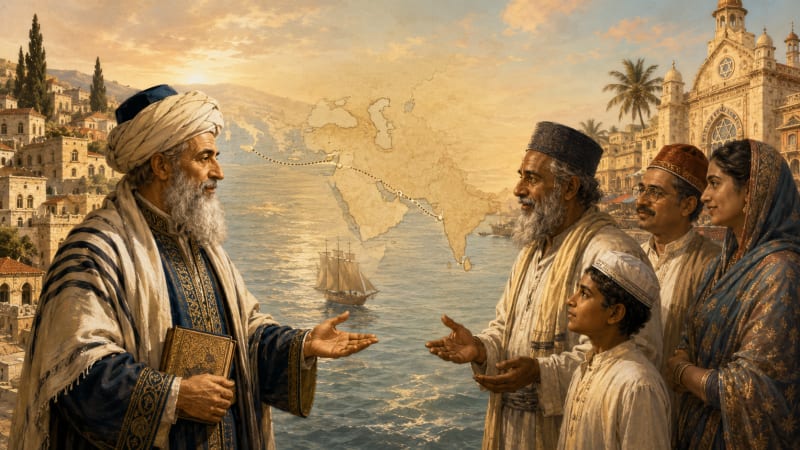
During the course of his activities, Rabbi Shmuel Abbo traveled to India and established connections with one of the most prominent Jewish families of the era: the Sassoon family.
David Sassoon, originally from Baghdad and settled in Bombay, had built a massive commercial network. The Sassoons were also great philanthropists: synagogues, schools, hospitals, libraries, and community institutions still bear their mark.
Shmuel Abbo developed a close relationship with them.
At Sassoon’s request, he even extended one of his stays in Bombay to help organize the local Jewish community's religious life, teach Torah, and serve in rabbinical roles.
It was there that he encountered the Bene Israel.
The Bene Israel in Search of Recognition
The Bene Israel were an ancient Jewish community in India.
For generations, relatively isolated from the other major centers of Judaism, they had preserved fundamental elements of their identity: Shabbat, certain dietary laws, circumcision, the recitation of the Shema, and the memory of their belonging to the people of Israel.
In the 19th century, the development of Bombay and the arrival of Jewish communities, especially from Baghdad, brought them back into contact with global Judaism.
But a difficulty arose.
Their Jewishness was questioned by some Jews who had come from elsewhere.
According to Charvit, their situation could become particularly humiliating: some refused to fully accept them into the community, to count them in the minyan, or to call them to the Torah.
The Bene Israel then sought the help of Rabbi Shmuel Abbo.
And the rabbi from Algeria took their cause seriously.
A Rabbi from Algiers Becomes Their Defender
Shmuel Abbo did not just express sympathy.
Upon his return to Eretz Israel, he brought the matter before the rabbis of Safed and Jerusalem.
In parallel, he taught the Bene Israel various aspects of religious practice in order to facilitate their integration with other Jewish communities.
During another stay in Bombay in 1859, he observed with satisfaction that his teachings had been followed.
Synagogues and a mikveh were established. The study of Torah and mitzvot developed. The rules of Shabbat, shechita, family purity, and brit milah were more structured according to rabbinical standards.
But above all, Shmuel Abbo worked to have the Bene Israel recognized as full members of the Jewish people.
Safed Writes to Bombay: Accept the Bene Israel
The story did not end with him.
His son, Rabbi Abraham Haim Abbo, continued this mission in India in 1869-1870.
On this occasion, the rabbis of Safed were consulted once again.
On 26 Tishrei 1869, Sephardic and Ashkenazi rabbis sent a long letter to the leaders of the Baghdadi Jewish community in Bombay, specifically to the sons of David Sassoon.
The message was clear:
The Bene Israel had to be integrated, and the rejection they faced had to end.
The sages of Tiberias also sent a letter conveying the same message.
Professor Charvit emphasizes that Shmuel Abbo played a primary role in this matter, particularly thanks to his personal knowledge of the Indian community.
The rabbis explicitly demanded an end to derogatory words and behaviors toward the Bene Israel.
They also understood the stakes: left out of the rest of the Jewish people, this community became a particularly vulnerable target for Christian missionaries who were very active in India at the time.
The answer, therefore, should not be exclusion.
It should be reconciliation.
Algeria, France, Eretz Israel, and India
The story of the Abbo family is fascinating precisely because it does not easily fit into our modern categories.
These were rabbis from Algeria, settled in Eretz Israel, who became French consular representatives, working with a great Jewish dynasty originating from Baghdad and settled in India, and advocating for a centuries-old Indian Jewish community.
Even in the 19th century, the Jewish world was a network connecting Algiers, Safed, Jerusalem, Baghdad, London, and Bombay.
And at the center of this network, a rabbi from Algeria could feel concerned enough about the fate of Jews living thousands of miles away to come to their defense.
This is perhaps the most beautiful part of this story.
The Bene Israel were different.
Their customs had evolved far from the major rabbinic centers. Their history was unusual. Some religious questions were genuinely complex.
But for Shmuel Abbo and the rabbis who followed him, the answer to this difference was not supposed to be contempt.
It was supposed to be study, guidance, and brotherhood.
Nearly Two Centuries Later, in Jerusalem
For us, this story obviously has a special resonance.
Leron comes from this Bene Israel community of India.
Binyamin comes from a Jewish family from Algeria.
We met, not in Bombay or Algiers, but in Jerusalem.
It would be artificial to pretend that our personal story is a direct continuation of the Abbos'. We don't need to invent a genealogy for this connection to be beautiful.
It is enough to note something quite extraordinary:
Nearly two hundred years before we met, a rabbi from Algeria had already crossed the seas, met the Bene Israel in India, and worked to ensure they were fully welcomed among their Jewish brethren.
Today, in our home, these two heritages literally live around the same table.
The flavors of India meet Sephardic and memory from Algeria. The stories of Bombay meet those of North Africa. And all this comes together in Jerusalem.
This is also the spirit of Kosher India and Or HaZeev: to show that there is not just one way to have traversed Jewish history.
There are dozens.
Algiers. Constantine. Safed. Bombay. Baghdad. Paris. Jerusalem.
Different languages, different cuisines, different melodies — but a history that, time and again, eventually brings the paths together.
And sometimes, you discover that this meeting had begun long before us.
Source: This article is based on the research of Professor Yossef Charvit, published notably in the chapter dedicated to the Abbo family and the Bene Israel in: Yossef Charvit, La France, l’élite rabbinique d’Algérie et la Terre sainte au XIXᵉ siècle : tradition et modernité, Éditions Honoré Champion, pp. 239–248. The pages used for writing this article are reproduced and their content presented with the authorization and blessing of Professor Yossef Charvit.